
Battery Replacement
The single most common repair we do. Generac's 12V standby battery lasts 3-4 years. When voltage drops below 12.1V the controller throws a Low Battery alarm and the unit won't crank when the outage hits.
Code 2750 · Low BatteryGenerac, Kohler, Cummins, Briggs & Stratton, and other whole-home standby generators. Failed exercise cycles, controller fault codes, no-start conditions, ATS transfer failures, oil pressure alarms, and everything in between. Real diagnostic work, honest repairs, no upsell into a new unit when a fix works.
Two installation waves put a lot of standby generators in Hunterdon County ground in the last 15 years. The first came after Hurricane Irene in 2011 and Superstorm Sandy in 2012, when multi-day JCP&L outages convinced thousands of homeowners in Readington, Tewksbury, Union Township, and rural Clinton Township to install a generator. Those units are now 12-14 years old and hitting real end-of-life issues on batteries, starters, controller boards, and coolant systems.
The second wave came in 2020-2022 during the remote work surge, when a JCP&L outage suddenly meant missed client deadlines and lost billable hours. Those newer units are just hitting their first major service inflection at the 5-year mark, and units that weren't kept on annual service are showing it.
Add in the July 2021 Nor'easter aftermath (only 80% of Hunterdon customers restored day 1) and the July 2024 thunderstorm outages, and you have a lot of units that were tested under actual load and exposed weaknesses. That's the reality behind our repair call volume.
Standby generator symptoms cluster around a handful of predictable failure modes. Pick your brand and the closest symptom on the right and we'll give you a rough read on the likely cause, urgency, and typical fix.
This is a starting point, not a full diagnosis. Fault codes need to be read off your controller and matched to actual test results.
For a real diagnostic, call (908) 751-4227.
Real repair categories with the fault codes and symptoms that come with each. Everything below is something we see monthly.
The single most common repair we do. Generac's 12V standby battery lasts 3-4 years. When voltage drops below 12.1V the controller throws a Low Battery alarm and the unit won't crank when the outage hits.
Code 2750 · Low BatteryEngine cranks but never fires. Usually fuel-related (empty propane tank, closed gas valve, failed fuel solenoid) or ignition-related (spark plug, coil pack). Most common fault code shown after failed exercise cycles.
Code 1100 · OvercrankController signals the starter to crank, but doesn't get the RPM confirmation signal back. Usually weak battery, corroded ground connections, or starter solenoid failure. Common on units 8+ years old.
Code 1501 / 1505 / 1515Either oil is genuinely low (annual service was skipped) or the oil pressure switch has failed. We check level and add oil first, then test the switch itself. Sometimes an internal engine issue requires deeper diagnosis.
Code 1300 · Low Oil PressureWeekly self-test stops running. Usually a battery issue, a set-time reset after a power event, or a controller software glitch. We reset, verify, and add remote monitoring where available so you know it ran.
Code 2730 · Exercise SetGenerator runs but doesn't transfer load to the house during an outage. Usually the automatic transfer switch (ATS), a control wire issue between generator and ATS, or a utility-side sensor that's stuck.
Transfer FailureAir-cooled units shut down on high temp, usually because the enclosure vents are blocked (leaves, mouse nests, snow drifts, mulch piled up), the intake screen is clogged, or the cooling fan has failed.
Code 1400 · High Engine TempThe 24-hour battery charger isn't maintaining float voltage. Common on older units where the charger board has failed, and after utility surges that damaged the charger circuit. Fast repair once diagnosed.
Code 2780 · Charger Missing ACEngine runs but hunts on RPM, surges under load, or won't hold clean 60Hz output. Usually governor issues, air filter clog, dirty fuel, or degraded spark plugs. Common right after multi-day runtime under load.
Governor FaultWe repair whatever brand you have on the pad. Here's the honest depth of experience per brand.
By far the largest installed base in Hunterdon County. We know Nexus and Evolution controllers, Guardian series, Protector series, and the full fault code library. Battery, starter, coil pack, and control board work all in-house.
Solid experience on 14RCA, 20RCA, and 26RCA residential units. Kohler's DEC controller and OnCue Plus monitoring platform. Kohler engines run longer between services than Generac equivalents in our experience.
Less common in our area than Generac or Kohler, but we work on them regularly. Simpler engine platform means most repairs are straightforward. Parts availability is the main constraint for older units.
QuietConnect and RS series units are showing up more in high-end Hunterdon installs. Robust build quality, longer service intervals. We service what we install and diagnose most third-party Cummins issues on site.
Generator diagnosis isn't guesswork. Modern standby units log their own faults, and reading the fault log correctly is 60% of the diagnosis. The other 40% is verifying with load testing and physical inspection.
You'll see us do each step and hear what we're finding. Written quote before any repair work. If we can't fix it in the initial visit, you know why before we leave.
Pull the full fault code history off the Nexus, Evolution, or DEC controller. Not just the current code, the last dozen. Patterns matter: a battery low warning followed by RPM sense loss tells a different story than either alone.
Full battery load test with a proper tester (not just a voltmeter). Verify float voltage on the charger, test cranking voltage under actual load. Roughly 40% of no-start calls end here.
Fuel pressure at the regulator, spark at each plug, coil pack integrity, air filter condition. Physical inspection of governor linkage. Weekly exercise runs revealed most starting problems, so cross-reference with logs.
Start the unit manually, confirm clean run, load test at rated capacity, then verify ATS transfer under simulated outage. Any transfer failure gets isolated to generator, ATS, or control wiring.
Not every generator issue is a mid-outage crisis. Here's how we prioritize the calls that come in.
JCP&L is out, your generator failed to start, or it started and shut down. Fuel or fumes visible. Any smell of burning wiring or overheated fuel from the unit.
Red controller light or active fault code and a Nor'easter forecast in 48-72 hours. Failed exercise cycle with no obvious cause. Any warning that would prevent an auto-start during an outage.
Haven't had it serviced in more than a year. Battery is 4+ years old and it's time. Unit is 5+ years old and you want a full health check before storm season. Cosmetic or minor issues.
The single biggest reason standby generators fail when you actually need them is skipped annual service. Generac, Kohler, and every other manufacturer specify annual service (or after 200 hours of runtime, whichever comes first). Skip it two years running and the odds of a mid-outage failure jump significantly.
Annual service is not just an oil change. It's a full health check on the systems that stay dormant for 51 weeks and have to work perfectly for 51 hours.
We do annual service on units we didn't install, and offer service plans that include priority mid-outage response for enrolled customers.
Full oil drain and refill with manufacturer-spec oil weight. New oil filter. New air filter or intake cleaning. The engine has been through 52 weekly exercise runs plus any outage runtime.
Spark plug condition tells you what the engine is doing internally. Fouled plugs mean rich running, worn plugs mean the ignition system is stressing to fire. Replaced per manufacturer spec.
Full load test with a proper battery tester, not just a voltmeter reading. Weak batteries pass a voltmeter and fail under actual cranking load. Replaced proactively at year 3-4.
Natural gas or propane pressure verification at the regulator, fuel line integrity, solenoid function. Propane tank level noted. Cold-weather fuel pressure considerations for winter.
Full history pulled off the controller. Cleared warnings that turned out to be one-off get noted; recurring warnings get investigated. Exercise cycle time verified and adjusted if needed.
Mice, voles, and squirrels love the warm interior of a generator enclosure. Nests get cleared, chewed wire insulation gets repaired, exhaust and intake screens verified. Rural HC properties especially.
Three repair jobs we've completed recently. Different brands, different failures, different fixes.
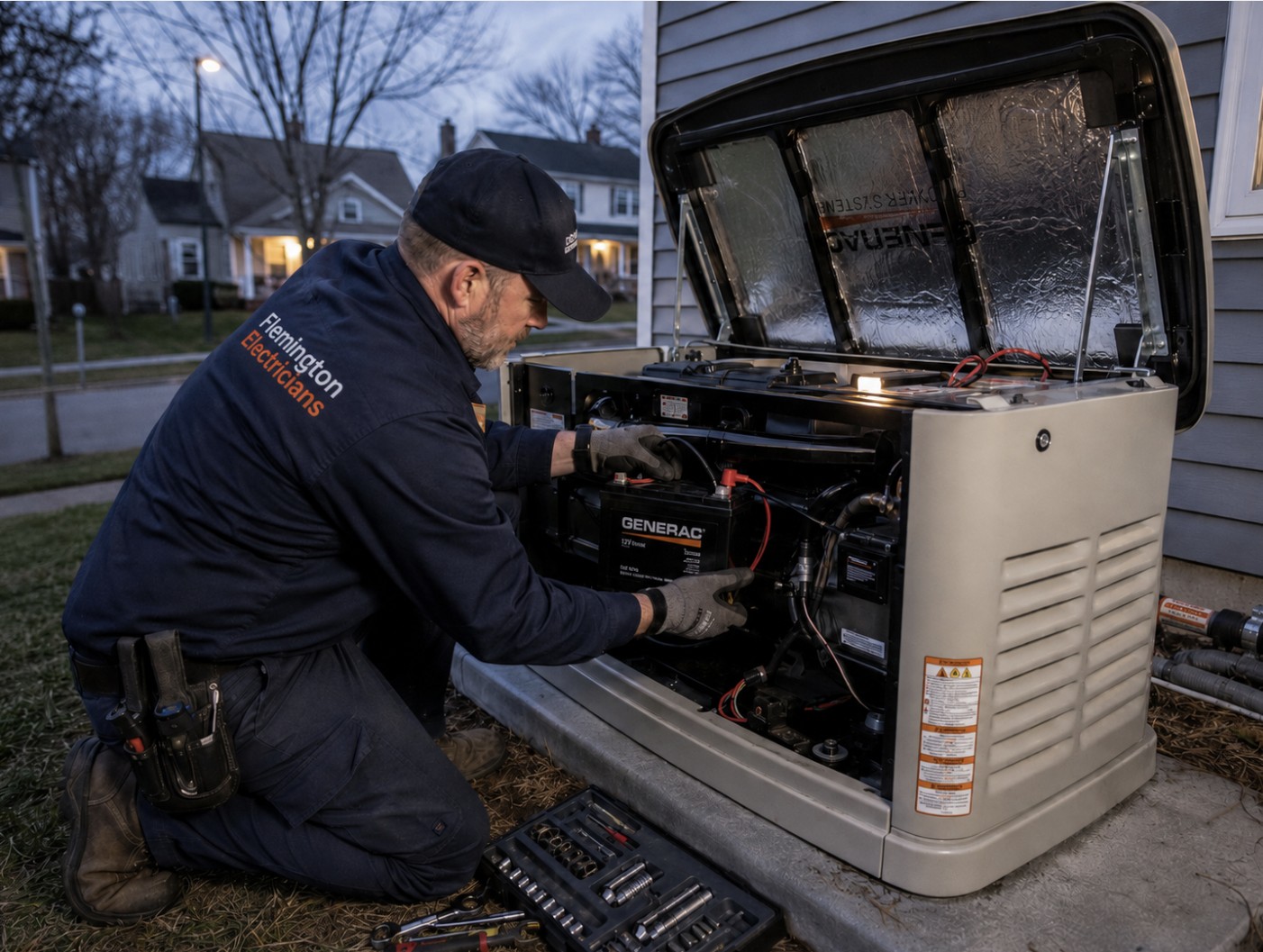 Mid-Outage Battery
2013 Generac 22 kW Guardian on Route 523. JCP&L outage hit at 2am after a summer thunderstorm, generator threw code 1501 (RPM Sense Loss) and never started. Battery load-tested at 9.2V under crank. Replaced battery on site, verified auto-start, house back on power in 45 minutes. Battery was original from install.
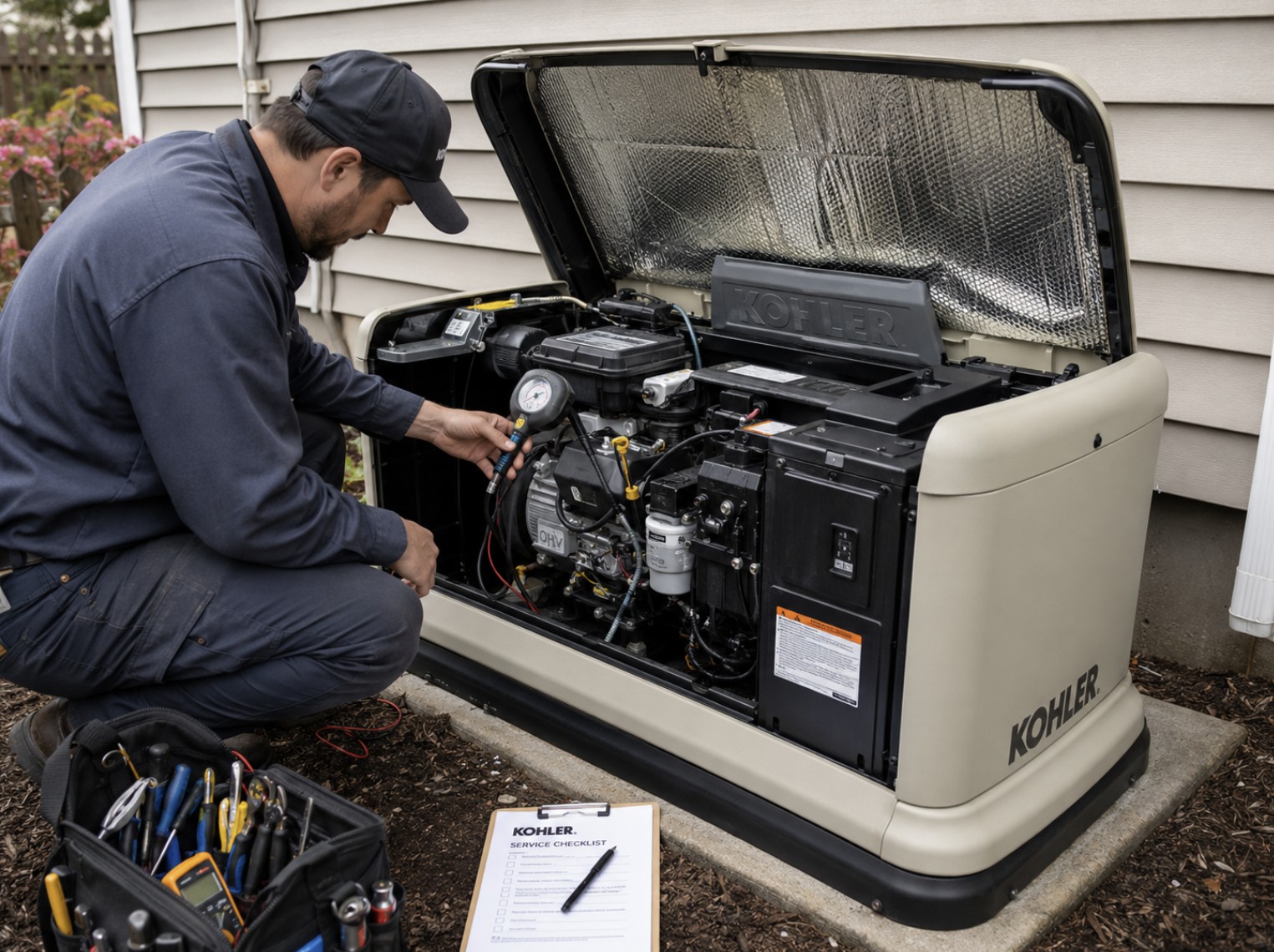 Oil Pressure Fault
2019 Kohler 20RCA on a property near Spruce Run Reservoir. Ran through the July 2024 thunderstorm outage for 26 hours straight, then threw a low oil pressure fault at the end. Oil was low from the extended runtime, no leak. Full oil service, replaced oil pressure switch (precautionary), tested at load. Owner scheduled onto annual service plan.
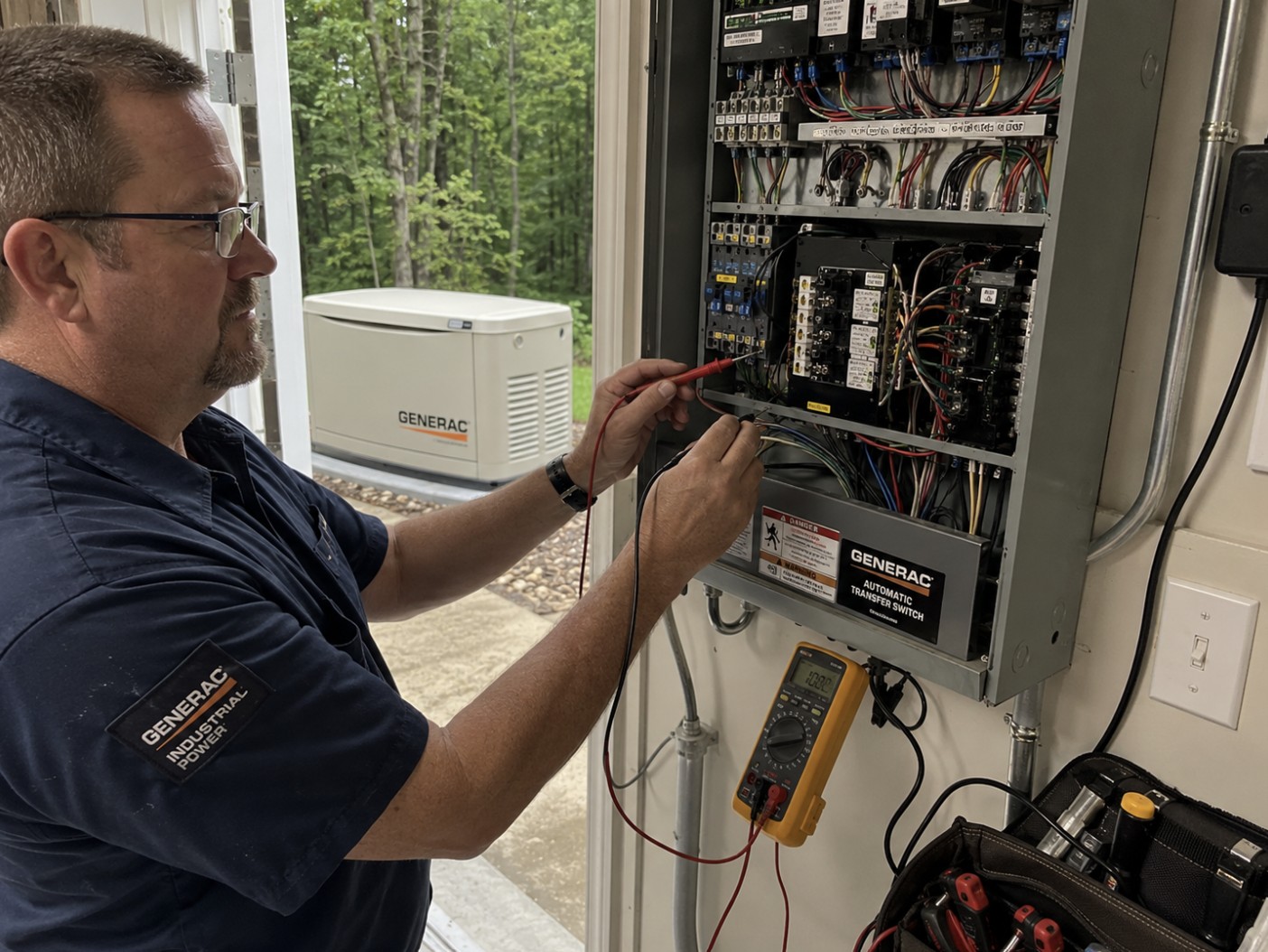 ATS Transfer Failure
2015 Generac 16 kW off Copper Hill Road. Generator was running fine on weekly exercise but during a brief JCP&L outage, engine ran but the house stayed dark. Diagnosed as a stuck ATS contactor from lack of exercise under load. Rebuilt the ATS contactor assembly, tested with simulated utility drop, cleared. Recommended monthly manual transfer test.
We install and service standby generators as an independent electrical company, not a factory-authorized dealer for any single brand. That has real trade-offs for warranty work that we want to be upfront about.
For units still under manufacturer warranty (typically 3-5 years for Generac, 5 years for Kohler), going through your original factory-authorized installer is usually the right path for warranty-covered parts. They can process claims directly, and warranty part replacement doesn't come out of your pocket.
For units past warranty, or when the original installer isn't responsive, or for repairs that aren't warranty-eligible anyway, we work on everything. Battery replacement, annual service, ATS repairs, and out-of-warranty part replacement are all fair game regardless of brand.
Generator repair pricing has three components: the diagnostic visit fee (disclosed up front before we head out), the parts required for the fix, and the labor to install and test. We give you a written itemized quote before any repair work starts.
What we can tell you: battery replacements and annual services are relatively affordable, especially with a service plan enrollment. Controller board failures, ATS rebuilds, and coolant system repairs on liquid-cooled units are more involved. Some parts require ordering and a follow-up visit.
Emergency mid-outage response has priority pricing that's disclosed before dispatch. Service plan customers get a discounted rate on emergency response.
Call our emergency line, (908) 751-4227. We prioritize mid-outage generator failures over standard service calls. If you're a service plan customer, you get priority routing. While you wait, do not attempt to force-start the unit. Take a photo of any fault code showing on the controller display, that speeds diagnosis when we arrive.
Annually at minimum, or after 200 hours of total runtime (whichever comes first). Manufacturers specify this in the owner's manual. Skipping annual service is the number one reason units fail during outages. Our annual service is comprehensive enough to catch developing issues before they become failures.
Typically 3-4 years for the 12V starting battery. In our experience units in unheated enclosures in rural Hunterdon County trend toward the shorter end of that range because of winter cold cycling. We recommend proactive replacement at year 3-4 rather than waiting for the Low Battery warning to appear right before a storm.
Red light means an active fault has stopped the generator from running. The controller display should show a fault code (like 1100, 1300, 1501, or 2800). Take a photo of the code and call us. The specific code narrows the diagnosis significantly, sometimes to a battery swap or an E-stop reset, sometimes to something more involved.
Usually the exercise time got reset after a power event (utility surge, dead battery), or there's an active fault preventing the cycle from starting. Sometimes the exercise cycle is running but at a time you don't hear it. Newer units with Mobile Link or OnCue send notifications when exercise runs successfully, so silent failure is easier to catch.
For homes that rely on the generator (well, septic, medical equipment, home office), yes. Service plans typically include the annual service, priority mid-outage response, and discounted repair labor. For homes with minimal outage impact, calling for annual service each year works too. We'll walk through the tradeoffs when you call.
Yes, this is a large portion of our repair business. Homeowners moving into a house with an existing generator, or customers whose original installer is no longer available, or units where the manufacturer dealer network is unresponsive. We service Generac, Kohler, Cummins, Briggs & Stratton, and other brands regardless of who installed them.
Depends on the specific issue. Battery, oil, spark plug, and air filter work is worth doing on any unit that's structurally sound. Controller board and major engine repairs on 15+ year old units sometimes cost more than the unit is worth against a new install. We're honest when a repair doesn't make economic sense and will suggest looking at new generator installation instead.
A real person picks up. Priority routing for mid-outage failures. Written quote before any repair work starts.
(908) 751-4227